Car Makes Popping Noise When Accelerating? (Here's Why)

April 18, 2025

eric

Car Makes Popping Noise When Accelerating? (Here's Why)

Hear a weird popping noise when you hit the gas? That sound could mean anything from a little hiccup in your exhaust system to something more serious like an engine misfire. Sometimes it’s a quick fix, other times it’s a “call your mechanic” kind of situation. In this post, we'll explain why your car makes popping noise when accelerating, and what you should do next.

Hear a weird popping noise when you hit the gas? That sound could mean anything from a little hiccup in your exhaust system to something more serious like an engine misfire. 
Sometimes it’s a quick fix, other times it’s a “call your mechanic” kind of situation.
In this post, we'll explain why your car makes popping noise when accelerating, and what you should do next.
SCHEDULE AN APPOINTMENT

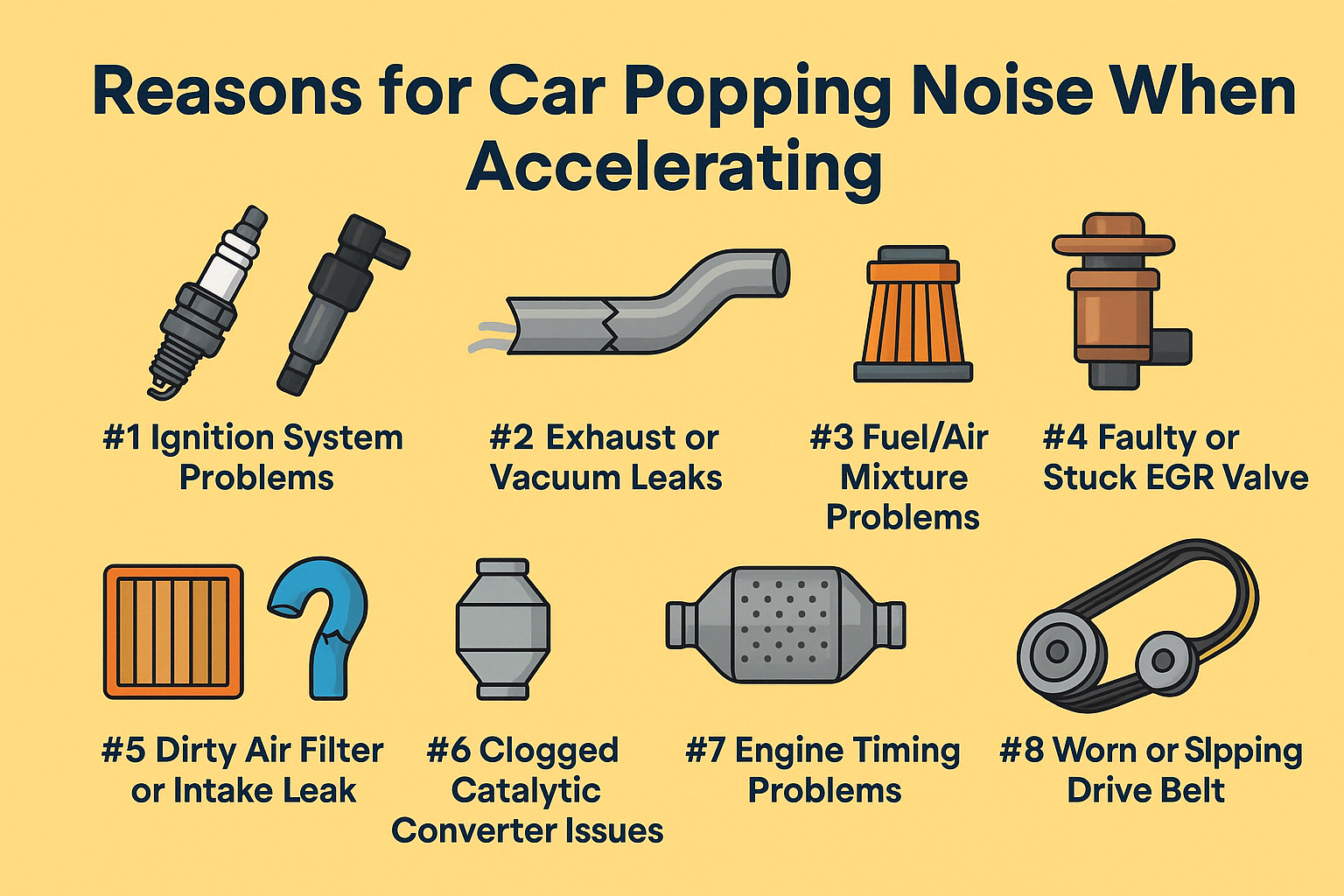
#1 Ignition System Problems

The ignition system is responsible for starting your engine and making sure it runs smoothly. 

If there's a problem here, you might hear popping sounds when accelerating. Things like a faulty spark plug, a bad ignition coil, or even a damaged distributor cap can all cause the noise. 


What’s happening is that the engine isn’t firing properly, which leads to incomplete combustion, and that’s when the popping sounds start.

If you’re noticing this issue, it might be time to check your spark plugs or the ignition system as a whole. And you might need to replace the spark plugs or coils. It's a relatively simple fix, and you can usually do it yourself if you're comfortable with a wrench.


Also Read: Whirring Noise After Engine Off


#2 Exhaust Or Vacuum Leaks

Exhaust or vacuum leaks are another reason behind popping noises when accelerating.

Exhaust leaks often happen in places where the exhaust system is cracked or has a hole, like the manifold or the exhaust pipes. This can cause a popping sound when the engine’s running. 


The air escaping through these leaks messes with the engine’s air-fuel mixture, which can make the car run rough.

Vacuum leaks can mess with the engine’s performance too. 


If there's a hose or seal that's cracked or loose, it can cause the engine to run lean (too much air and not enough fuel - more on this next). This imbalance can lead to popping sounds as the engine struggles to adjust.

#3 Fuel/Air Mixture Problems

The fuel and air mixture in your engine needs to be just right for the car to run smoothly. If there’s too much air or not enough fuel (or vice versa), the engine might misfire or pop. 


This imbalance can happen for many reasons like:

  • Dirty fuel injector
  • Clogged air filter
  • Malfunctioning mass air flow sensor


The popping happens because the engine isn’t getting the right balance of fuel and air it needs. You can usually notice this problem if your car is running rough, stalling, or hesitating when you press the gas. If that’s the case, it’s worth having your fuel system and air intake checked out. A mechanic might clean out your fuel injectors, replace the air filter, or recalibrate your air-fuel ratio sensor.


Also Check Out Our: Fuel System Services 

#4 Faulty Or Stuck EGR Valve

The EGR (Exhaust Gas Recirculation) valve helps reduce emissions by redirecting some of the exhaust gases back into the combustion chamber. 

If this valve becomes faulty or stuck, it can cause problems in how the engine burns fuel, which leads to a rough running engine and, you guessed it, popping sounds. 


This problem is pretty common in older cars, and you might notice other signs of poor engine performance like poor acceleration or stalling.

If you suspect a problem with the EGR valve, it’s best to have it inspected by a mech.

#5 Dirty Air Filter Or Intake Leak

The air filter is responsible for making sure the air going into your engine is clean. Over time, it can get clogged with dirt, dust, and other debris. 

When that happens, the engine isn’t getting enough air, which can cause a popping noise. 


And if there’s a leak in the intake system, it can cause an imbalance in the air-fuel mixture, which also leads to popping sounds.

Fixing this is usually quick and inexpensive.

#6 Clogged Catalytic Converter Issues

The catalytic converter helps reduce harmful emissions by turning them into less harmful substances. This too can get clogged over time with carbon buildup. This can cause poor engine performance, strange noises, and even a popping sound during acceleration. 


If the converter is the issue, you’ll probably notice a decrease in engine power, along with a noticeable smell from the exhaust.

Replacing a catalytic converter can be expensive, but you should be able to unclog it.

#7 Engine Timing Problems

Your car’s engine needs to have precise timing for everything to run smoothly. If the timing is off, you could hear all sorts of strange noises, including popping sounds when you accelerate. This is often caused by a worn timing belt or chain, or a problem with the timing gears. 

If the timing is seriously off, it can lead to engine misfires, and you might notice the car running roughly or even stalling. Getting the timing checked out is important because driving with faulty timing can cause more serious damage to the engine over time. A mechanic can fix this issue by adjusting the timing or replacing the timing components if needed.

#8 Worn Or Slipping Drive Belt

The drive belt helps run a number of important components in your car, like the alternator, power steering pump, and air conditioning compressor. 

If the belt becomes worn or starts slipping, it can make a popping or snapping sound when you accelerate.

This is accompanied by other signs, like strange noises from the engine or difficulty steering. Replacing a worn or slipping drive belt is a relatively simple fix, and it’s something you can usually do yourself if you’re comfortable working under the hood.


Also Check Out Our: Serpentine Belt Replacement Services

How To Fix Car Popping Noise When Accelerating

So, how do you fix that annoying popping noise? 


First, you’ll need to figure out what’s causing the problem. Start by checking simple things like your spark plugs, air filter, and vacuum hoses. If those are all good, it might be worth checking your ignition system, fuel mixture, or catalytic converter. Some of these fixes are easy to handle yourself, while others might need a mechanic’s help.


If you’re not sure where to start, it’s never a bad idea to take your car in for a check-up.

Bottom Line

A popping noise when you accelerate is usually a sign that something’s off under the hood. It could be something simple like a dirty air filter or something more complex like an ignition issue.  Either way, it’s worth looking into before it turns into a bigger problem. 


Don’t ignore those popping sounds, take a moment to check it out. The sooner you catch the issue, the easier (and less expensive) it’ll be to fix. So, keep your ears open!


SCHEDULE AN APPOINTMENT
By Christian Mosley July 8, 2026
Most vehicle owners only visit a repair shop when something goes wrong. A strange noise, a warning light, a sudden loss of power. By that point, what could have been a minor fix has often turned into a costly repair. That's the reality preventive maintenance is designed to prevent.  At Exclusive Imports , we see it regularly. Customers come in for LA Pine auto repair after ignoring a small issue for months, only to find out the damage has spread. The good news? Most of it was avoidable. This blog breaks down what preventive maintenance actually involves, why it matters for your specific vehicle, and what happens when it gets skipped. What Is Preventive Auto Maintenance? Preventive maintenance is a scheduled, proactive approach to vehicle care. Instead of waiting for problems to appear, you address wear before it becomes damage. It covers the systems your vehicle depends on daily: Engine oil and filter changes Brake inspections and fluid checks Tire rotations and alignment Coolant flushes and radiator checks Transmission fluid service Air filter replacements Battery and electrical system checks These are not optional extras. They are the foundation of a reliable vehicle. Why Preventive Maintenance Saves You Money A single neglected maintenance item can trigger a chain of failures. Old engine oil, for example, loses its ability to lubricate. Metal parts begin to wear against each other. Over time, that leads to engine damage that can cost thousands of dollars to repair. Preventive care addresses problems at the source, before they escalate. Consider what gets protected: Engine life : Clean oil and proper fluid levels reduce internal friction and extend engine longevity Brake safety : Catching worn pads early prevents rotor damage, which is significantly more expensive to fix Transmission reliability : Fluid services keep the transmission shifting smoothly and prevent premature failure Fuel efficiency : A well-maintained engine burns fuel more efficiently, which lowers your costs at the pump The math is straightforward. Routine maintenance costs a fraction of what major repairs do. How Vehicle Type Affects Your Maintenance Needs Not every vehicle follows the same maintenance schedule. European cars, diesel trucks, and Japanese vehicles each have specific requirements that demand specialized knowledge. European Vehicles: Precision Engineering Requires Precision Care European vehicles like Audi are engineered with tight tolerances and advanced systems. Skipping a service interval on an Audi can lead to issues that are difficult and expensive to diagnose without the right expertise. At Exclusive Imports, our Audi service and repair work is performed by ASE-certified technicians who understand European engineering at a detailed level. The same attention applies to other European makes that pass through our shop. Key considerations for European vehicles: Longer oil change intervals with manufacturer-specific oil grades Complex electronic systems that require advanced diagnostic tools Higher sensitivity to low-quality parts or incorrect fluid specifications Diesel Trucks: Built Tough, But Not Immune to Wear Diesel engines are known for their durability, but they require consistent maintenance to stay that way. Fuel system care, air filtration, and cooling system health are especially critical for diesel-powered trucks. Neglecting these can result in injector failure, turbocharger damage, or excessive soot buildup. All of these are expensive repairs that preventive service can help avoid. Japanese Vehicles: Reliable by Design, Maintained by Habit Japanese vehicles have a strong reputation for longevity. But that reputation is built on consistent maintenance, not on the assumption that nothing will ever go wrong. Timing belt replacements, transmission fluid services, and cooling system flushes are areas where Japanese vehicle owners often delay too long. Staying on schedule keeps these vehicles running well beyond 200,000 miles. Common Repairs That Preventive Maintenance Prevents Understanding what goes wrong when maintenance is skipped helps clarify why it matters. Engine Damage From Neglected Oil Changes Old or low engine oil leads to metal-on-metal contact inside the engine. This causes accelerated wear and, in severe cases, complete engine failure. An oil change costs a small fraction of what an engine rebuild or replacement does. Brake Failure From Worn Pads Brake pads wear down gradually. When they wear too far, the metal backing contacts the rotor directly, causing deep grooves and compromised braking performance. Catching pad wear early means replacing pads only. Waiting too long means replacing pads and rotors. Transmission Problems From Fluid Neglect Transmission fluid degrades over time. It loses its ability to protect internal components and regulate temperature. When transmission fluid is serviced on schedule, the transmission lasts significantly longer and shifts more reliably. Overheating From Cooling System Issues A failing thermostat, low coolant, or a clogged radiator can cause an engine to overheat. Overheating causes serious internal damage. Cooling system maintenance is a low-cost service that protects one of your most expensive components. Exclusive Imports: Specialists Who Know Your Vehicle Exclusive Imports is a trusted La Pine auto services provider serving the local community with honesty and expertise. Our team of ASE-certified technicians works on all makes and models, with deep specialization in European cars, diesel trucks, and Japanese vehicles. We are also a recognized Cadillac repair shop and Fiat repair shop, giving us a broad range of domestic and imported vehicle experience under one roof. What sets us apart: ASE-certified mechanics with hands-on experience across vehicle types Honest assessments with no upselling or unnecessary recommendations A 24-month / 24,000-mile warranty on covered repairs Convenient after-hours drop-off and a comfortable waiting room Financing options available for larger repairs Our approach is simple: we treat every vehicle like it belongs to someone we know, because it does. We are your neighbors, and we want your vehicle to keep you safe on the road. Don't Wait for a Warning Light Preventive maintenance is not about spending money unnecessarily. It is about protecting the investment you have already made. Your vehicle is one of the most important tools in your daily life, and keeping it in good shape is one of the most practical decisions you can make. Ready to get ahead of costly repairs? Schedule your preventive maintenance appointment with Exclusive Imports today. Our team is ready to inspect your vehicle, answer your questions honestly, and keep your car, truck, or SUV running at its best. Your vehicle deserves expert care. Exclusive Imports is here to provide it.
By Christian Mosley June 12, 2026
Watch for common diesel truck warning signs like engine issues, smoke, or power loss. Get timely repair service to prevent costly breakdowns.
Why Regular Maintenance Is Essential for European Luxury Vehicles
By Christian Mosley June 3, 2026
Regular maintenance keeps your European luxury vehicle performing at its best. Prevent costly repairs, extend its lifespan, and ensure reliable driving.
Understanding Your Repair Estimate: What You’re Really Paying For
By Christian Mosley April 29, 2026
Learn what goes into your repair estimate, including parts, labor, diagnostics, and maintenance costs, so you can make informed auto service decisions.
Winter in La Pine: Is Your Vehicle Ready for the Cold?
By Christian Mosley April 20, 2026
Get your vehicle ready for winter in La Pine with expert cold weather car care tips. Learn how to protect your battery, tires, brakes, and fluids.
By Christian Mosley April 17, 2026
Understand ASE certification and how it protects you from costly repairs while ensuring expert vehicle service.
Fleet Downtime Is Business Down—Here’s How We Keep Your Vehicles Moving
By eric January 14, 2026
Minimize costly fleet downtime with expert maintenance and repair services that keep your vehicles road-ready. Please visit to learn more.
Top Five Signs Your Diesel Truck Needs Immediate Attention
By eric December 10, 2025
Discover the top warning signs your diesel truck needs immediate attention. Prevent breakdowns, costly repairs, and safety risks with expert tips. Visit and read more.
Modern Diagnostics: How Cars Reveal Problems Early
By eric November 10, 2025
Discover how modern car diagnostics detect problems early, prevent costly repairs, and keep your vehicle running smoothly. Learn the signs your car may be trying to tell you.
Why Disc Brakes Get Hot on One Side and How to Fix It
By eric October 14, 2025
Disc brake hot on one side? Learn common causes like a sticking caliper, frozen slide pins, or a collapsed hose, plus simple checks and fixes.